

|



CAN Test Box OBD2 Breakout Box and Protocol Detector for Vehicle Diagnostics


-
- Product Name: CAN Test Box OBD2 Breakout Box and Protocol Detector for Vehicle Diagnostics
- Item NO.: 29491009
- Weight: 1 kg = 2.2046 lb = 35.2740 oz
- Category: ALL CATEGORIES > Hot Car Accessories
- Creation Time: 2026-09-15
When diagnosing vehicle communication problems, simply connecting a scan tool and reading fault codes is sometimes not enough. Technicians may need to check the actual signals, power supply, ground connections, CAN communication, or K-Line activity directly at the OBD connector.
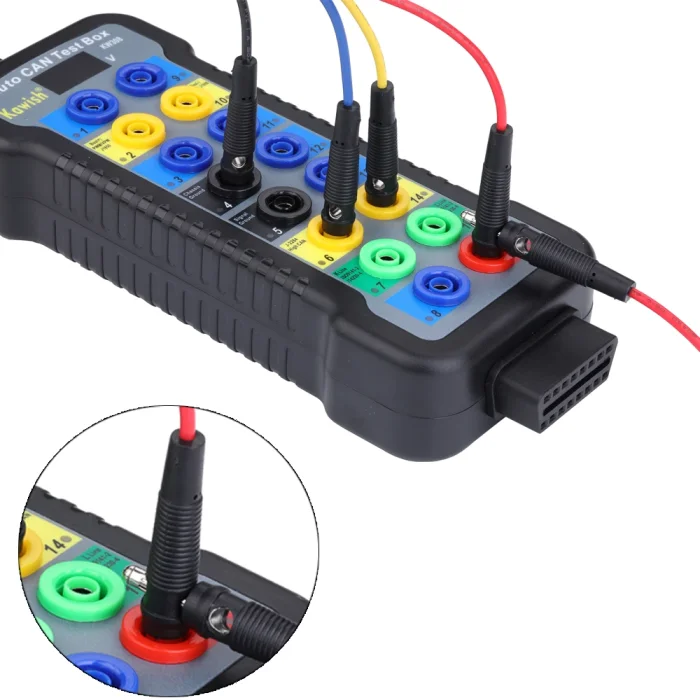
The CAN Test Box Breakout Box and Protocol Detector is designed for this type of diagnostic work. It works as an OBD2 extension, signal breakout box, protocol detector, and voltage monitor in one compact device.
With support for all 16 OBD pins, LED signal indicators, 4mm banana sockets, voltage monitoring from 8–30V, and a built-in flashlight, this OBD2 test box can make electrical and communication testing much easier.
What Is an OBD2 Breakout Box?
An OBD2 Breakout Box is a diagnostic testing device installed between a vehicle's Diagnostic Link Connector (DLC) and an automotive scan tool.
Instead of hiding the electrical signals inside the OBD connector, the breakout box exposes the individual pins so technicians can monitor them with test equipment.
Why Use an OBD2 Breakout Box?
A breakout box can be useful when troubleshooting problems such as:
- No communication between the vehicle and scan tool
- Incorrect battery voltage
- Poor ground connection
- CAN bus communication problems
- K-Line communication issues
- Intermittent ECU activity
- OBD connector wiring problems
Direct Access to OBD Signals
The CAN Test Box provides access to all 16 OBD2 pins. This allows a technician to connect a multimeter or oscilloscope directly to the required signal without repeatedly probing the vehicle's OBD connector.
Five Functions in One CAN Test Box
This device combines five practical functions into one diagnostic box, making it useful for automotive electrical and communication testing.
1. OBD2 Male-to-Female Extension Cable
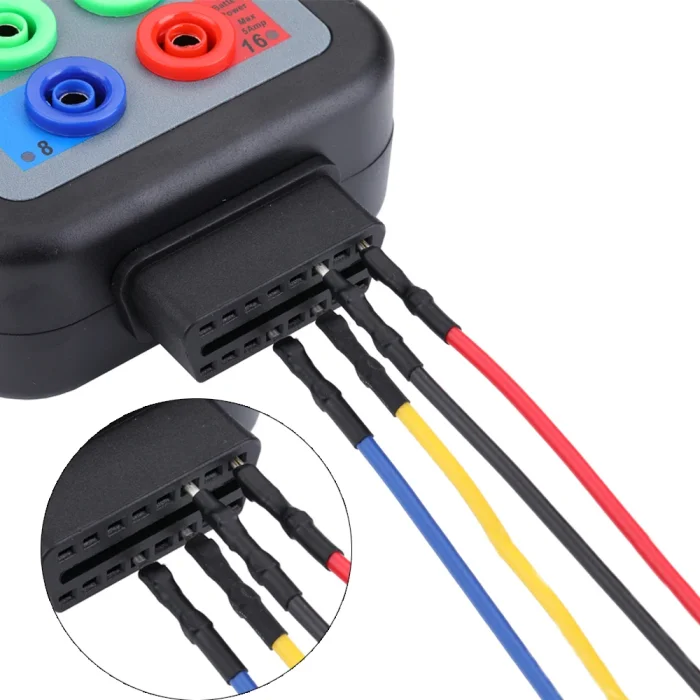
The box includes a 1.5-meter OBD2 male-to-female extension cable.
The extension cable can be connected between the vehicle's Diagnostic Link Connector and the scan tool.
1.5-Meter Cable for Easier Testing
The extended cable gives technicians more working space around the vehicle. The scan tool can remain in a convenient position while the OBD connector and test box stay accessible for electrical measurements.
This is especially useful when a technician needs to monitor signals while operating diagnostic equipment at the same time.
2. 16-Pin OBD Signal Breakout
The CAN Test Box provides 16 high-quality 4mm banana sockets, corresponding to the 16 pins of the standard OBD connector.
These sockets make it easier to connect external testing equipment.
Connect a Multimeter or Oscilloscope
Technicians can use the banana sockets to connect:
- Digital multimeters
- Oscilloscopes
- Automotive test meters
- Other compatible electrical testing equipment
Instead of directly back-probing the OBD connector, the signals can be accessed through the breakout box.
3. OBD Signal Detection with 16 LED Indicators
One of the main features of this OBD2 protocol detector is its 16 LED signal indicators.
Each LED corresponds to an OBD connector pin and provides a visual indication of signal activity.
Visual OBD Signal Monitoring
When communication or electrical activity is detected, the corresponding LED can illuminate or flash.
This provides a quick visual reference before performing more detailed measurements with a multimeter or oscilloscope.
Detecting ECU Communication Activity
Flashing LEDs can help indicate ECU communication activity on supported vehicle networks.
This can be useful when a scan tool cannot communicate with a vehicle and the technician needs to determine whether there is visible activity on the relevant OBD pins.
Supported OBD Communication Signals
The OBD signal detection function can detect several common automotive communication and electrical signals, including:
- PWM
- VPW
- ISO 9141-2
- ISO 14230-4
- CAN Bus
- SAE J1939
- Power supply
- Ground
The device can therefore be used with various 12V passenger vehicles and 24V diesel applications, depending on the vehicle communication system.
4. Built-In Battery Voltage Monitor
The CAN Test Box also includes a built-in 3-digit blue LED voltmeter for monitoring vehicle voltage.
The voltage display has a resolution of 0.1V and a measuring range of 8–30V.
Monitor 12V and 24V Vehicle Voltage
The 8–30V measurement range makes the box suitable for checking voltage on common 12V automotive systems as well as many 24V diesel applications.
The voltage value is displayed continuously, allowing technicians to observe the vehicle's power supply during diagnostic work.
Why Voltage Monitoring Matters
Insufficient or unstable vehicle voltage can cause diagnostic communication problems and may lead to unexpected behavior from ECUs or scan tools.
With the integrated voltage display, technicians can quickly check whether the vehicle's supply voltage is within the expected range before continuing with further diagnosis.
5. OBD Connector Flashlight Function
Another practical feature is the built-in flashlight on the OBD connector.
A button is integrated into the connector, allowing the flashlight to be activated when working in dark areas.
Useful for Working Under the Dashboard
The OBD connector is often located underneath the dashboard, where lighting conditions may not always be ideal.
The integrated flashlight can illuminate the connector area, making it easier to locate and connect the OBD plug without needing to hold a separate flashlight.
CAN Bus and Diesel Diagnostic Applications
The CAN Test Box is not limited to basic OBD2 signal checking. Its signal detection capability also makes it useful for certain diesel vehicle applications.
CAN Bus Testing
CAN Bus communication is widely used for communication between vehicle control modules.
The breakout box allows technicians to access CAN-related OBD pins and observe signal activity through the LED indicators or external testing equipment.
SAE J1939 Testing
For supported diesel applications, the device can also detect SAE J1939 CAN bus signals.
This can be useful when working with commercial vehicles and other 24V diesel systems that use J1939 communication.
K-Line and L-Line Detection
The test box can also detect supported K-Line and L-Line communication signals.
This makes it useful for troubleshooting vehicles that use older diagnostic communication protocols alongside newer CAN-based systems.
How to Use the OBD2 Breakout Box
Using the CAN Test Box is straightforward.
Step 1: Connect the OBD2 Cable
Connect the male OBD2 connector to the vehicle's Diagnostic Link Connector.
Step 2: Connect the Scan Tool
Connect the diagnostic scanner to the female OBD2 side of the test box.
The test box is now positioned between the vehicle and the scan tool.
Step 3: Check the Voltage Display
Turn on the vehicle ignition and observe the integrated voltage display.
The 3-digit LED meter provides a continuous voltage reading between 8V and 30V.
Step 4: Observe the 16 LED Indicators
Check the LED indicators corresponding to the OBD pins.
Flashing indicators can provide a quick visual reference for signal or communication activity.
Step 5: Perform Detailed Signal Testing
If additional diagnosis is required, connect a multimeter or oscilloscope to the appropriate 4mm banana socket.
This allows the technician to perform more detailed electrical measurements.
Who Can Use This OBD Test Box?
The CAN Test Box can be useful for different types of automotive diagnostic work.
Automotive Technicians
Professional technicians can use it when diagnosing OBD connector, power, ground, and communication problems.
ECU and Automotive Electronics Technicians
For technicians working with ECUs and vehicle communication networks, direct access to OBD signals can make electrical testing more convenient.
Diagnostic Tool Users
It can also be useful alongside professional scan tools when a communication problem requires additional electrical testing.
CAN Test Box Specifications and Features
The main functions can be summarized as follows:
Feature Description OBD2 Extension Cable 1.5-meter male-to-female cable Signal Breakout All 16 OBD pins Test Sockets 16 × 4mm banana sockets LED Detection 16 LED indicators Voltage Monitor 8–30V Voltage Resolution 0.1V Display 3-digit blue LED Signal Detection PWM, VPW, ISO 9141-2, ISO 14230-4, CAN, SAE J1939 Vehicle Systems 12V cars and supported 24V diesel vehicles Flashlight Built into OBD connector External Testing Multimeter and oscilloscope compatible Why Choose an OBD2 Breakout Box for Diagnostics?
An OBD2 breakout box does not replace a professional diagnostic scanner. Instead, it complements the scanner by providing direct access to the electrical signals behind the diagnostic connector.
Faster Initial Signal Checking
The LED indicators provide a quick way to check for visible signal activity without immediately connecting an oscilloscope.
Easier Electrical Measurements
The 4mm banana sockets provide convenient connection points for test equipment.
Convenient Voltage Monitoring
The integrated voltmeter allows the technician to check vehicle voltage without using a separate meter for a basic voltage check.
More Convenient Workshop Testing
The combination of an extension cable, breakout terminals, LED indicators, voltage display, and flashlight makes the device practical for everyday diagnostic work.
FAQ About the CAN Test Box
Does the CAN Test Box work with all OBD2 vehicles?
The box is designed to access the standard 16-pin OBD connector and detect supported automotive signals. Actual communication protocols depend on the vehicle and its electrical system.
Can I connect an oscilloscope to the breakout box?
Yes. The 16 individual 4mm banana sockets are designed to provide convenient access to OBD signals for compatible test equipment such as multimeters and oscilloscopes.
Can it test 24V diesel vehicles?
The voltage monitor supports 8–30V, and the signal detection function supports certain 24V diesel communication systems, including SAE J1939.
Does it replace an OBD2 scanner?
No. It is primarily a testing and signal monitoring tool. It can be used together with an OBD2 scanner to investigate electrical and communication problems.
What is the purpose of the flashing LEDs?
The LEDs provide a visual indication of detected activity on the corresponding OBD pins. Flashing can indicate communication or ECU activity on supported signals.
Final Thoughts
The CAN Test Box Breakout Box and Protocol Detector is a practical tool for technicians who need more than simple fault-code reading. By combining a 1.5-meter OBD2 extension, 16-pin signal breakout, 16 LED indicators, 4mm banana sockets, an 8–30V voltage monitor, and a built-in flashlight, it provides several useful testing functions in one device.
For automotive electrical diagnosis, CAN bus testing, K-Line troubleshooting, OBD connector checking, and supported diesel communication testing, this type of breakout box can provide a convenient bridge between the vehicle, scan tool, and professional test equipment.
You May Also Like
-
 LAUNCH PFP100 Programming Flash Power Car Diagn...US$ 809.10 US$ 899.00
-
 GODIAG BCP U KEY BDC2 BDC3 14-in-1 Adapter Kit ...US$ 116.10 US$ 129.00
-
 CAN Test Box OBD2 Breakout Box and Protocol Det...US$ 89.10 US$ 99.00
-
 T261 Car Tire Pressure Diagnose Tool Automotive...US$ 179.10 US$ 199.00
-
 3in1 Ultra CAN-II CAN Analyzer Supports for USB...US$ 116.10 US$ 129.00
-
 Original T48 TL866-3G Programmer Chip Repair To...US$ 89.10 US$ 99.00
-
 Cummins Inpower Pro Diagnostic Scanner V14.5 In...US$ 719.10 US$ 799.00
-
 ECU Probe Programming Bracke Solderless Solutio...US$ 62.10 US$ 69.00
Recently Viewed
-
 JLR Mangoose SDD V164 Auto Diagnostic ScabTool...US$ 62.91 US$ 69.90
-
Cummins Inpower Pro Diagnostic Scanner V14.5 In...US$ 719.10 US$ 799.00
-
ECU Probe Programming Bracke Solderless Solutio...US$ 62.10 US$ 69.00
-
 AIKKEY K3 OBD Key Programmer Review: CAN FD Sup...US$ 170.10 US$ 189.00
- Company Info
- Feedback
- Customer Reviews
- About Us
- Contact Us
- News
- User Center
- Forget Password
- My Orders
- Tracking Order
- My Account
- Register
- Payment & Shipping
- Customs & Taxes
- Locations We Ship To
- Shipping Methods
- Payment Methods
- Company Policies
- Return Policy
- Privacy Policy
- Terms of Use
Customer Reviews